
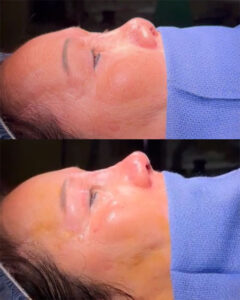
 Learn why rib cartilage is often used in rhinoplasty for long-term nasal support, and why donor rib cartilage can be a safe, effective alternative to using your own.
Why Cartilage Support Matters in Rhinoplasty
When we perform a rhinoplasty, we’re reshaping and refining the nose’s structure. In many cases, especially when we’re opening the nasal tip, some of the nose’s natural support is removed to achieve the desired contour. To maintain proper shape and long-term support, we need to replace that structure — typically using cartilage grafts.
In nearly every rhinoplasty I perform, I place cartilage grafts to reinforce or refine the nasal tip and support other areas of the nose.
When Nasal Cartilage Isn’t Available
In primary rhinoplasty, there’s usually enough cartilage inside the nose (from the septum) to work with. But in revision rhinoplasty or cases where septal cartilage is limited, we need another source. The two common sources rhinoplasty surgeons use are ear cartilage or rib cartilage.
While ear cartilage can be useful in some cases, it’s not my preferred material. Ear cartilage tends to be brittle, soft, and irregularly shaped, making it difficult to provide the strength and structure needed for nasal support.
Rib cartilage provides the most reliable source of strong, straight graft material for rhinoplasty. It can come from the patient’s own rib (autologous cartilage) or from donor rib cartilage.
Donor cartilage is widely used in many areas of medicine — including orthopedic surgery, reconstructive procedures, and tendon and bone grafts. In rhinoplasty, donor rib cartilage has been studied extensively and consistently shown to be safe and effective. Research demonstrates that it behaves no differently than a patient’s own rib cartilage once it’s incorporated into the nose.
Benefits of Using Donor Rib Cartilage
In my practice, I use donor rib cartilage when the patient’s septal cartilage is insufficient because it offers several important advantages:
- No additional incision: Using donor tissue avoids the need for a chest incision to harvest your own rib.
- Reduced risk: There’s no risk of chest scarring, infection, or pneumothorax (a small risk when harvesting rib).
- Shorter surgery time: Since the graft is ready to use, operating room and anesthesia time are significantly reduced.
- Equal performance: Most importantly, donor rib cartilage acts just like your own — providing strong, stable support for long-term rhinoplasty results.
In my experience, donor rib cartilage offers a safe, efficient, and highly effective option for many patients — helping achieve beautiful results while minimizing recovery and risk.