
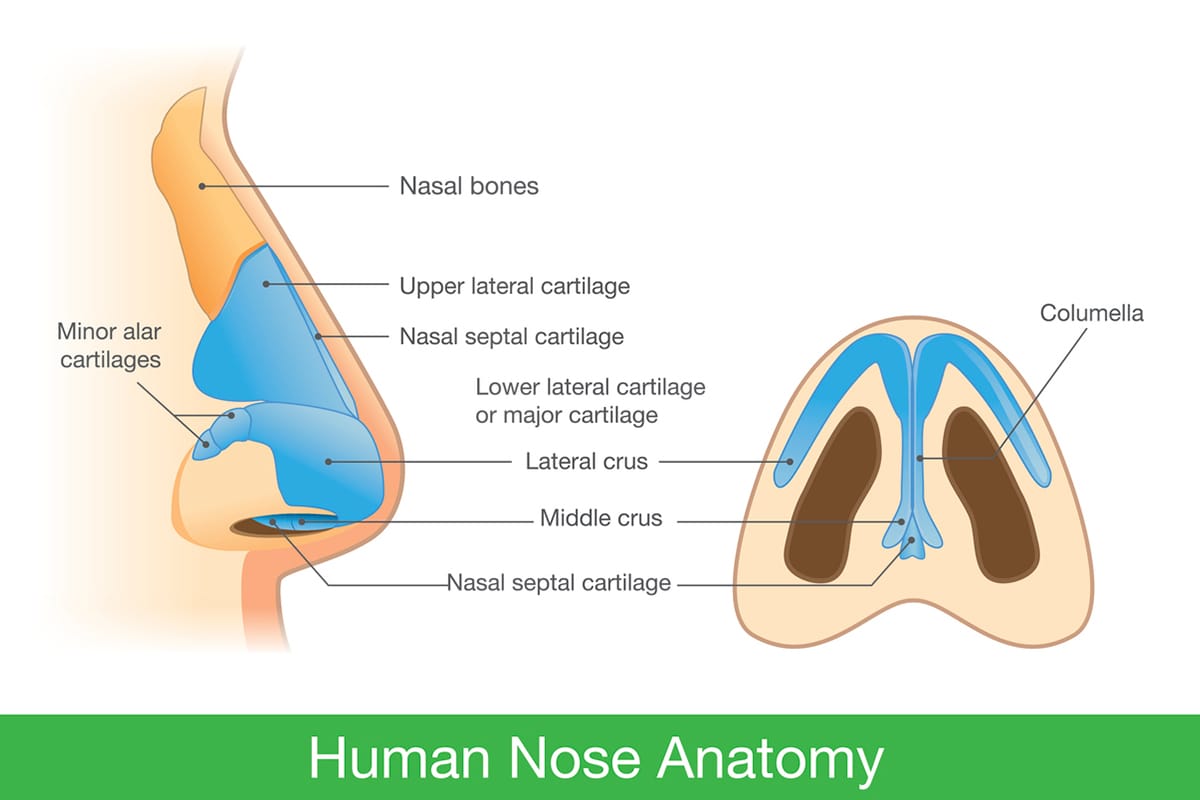
When performing rhinoplasty, one of the most important goals is to create a nose that looks natural and maintains its shape over time. A critical component of this is cartilage support.
During surgery, some of the nose’s natural support structures are intentionally adjusted or disrupted to achieve the desired aesthetic outcome. To restore and reinforce this support, surgeons rely on specialized cartilage grafting techniques. Below are some of the most commonly used grafts.
The Columellar Strut Graft
One of the most basic and frequently used techniques in rhinoplasty is the columellar strut graft.
This involves placing a small piece of cartilage between the medial crura (the central support structures of the nasal tip). Usually, septal cartilage is used, but in cases where septal cartilage is insufficient, cartilage may also be taken from the rib.
What it does:
- Restores support lost during surgery
- Stabilizes the nasal tip
- Helps prevent tip drooping over time
The graft is secured with sutures and acts as an internal brace, reinforcing the tip while maintaining a natural appearance.
The Caudal Septal Extension Graft
For patients who require stronger or more precise tip support, a caudal septal extension graft is often a better option.
This technique uses a piece of cartilage (often from the septum or a rib) that is attached directly to the existing nasal septum, effectively extending it forward.
Key advantages:
- Provides superior structural support compared to a columellar strut
- Allows for greater control of tip projection and position
- Offers long-term stability
The graft can be placed on one or both sides of the septum and is firmly secured with sutures. The nasal tip structures (medial crura) are then attached to this extension, creating a strong and stable framework.
This is often the preferred approach in cases where:
- The patient has weak tip support
- Significant reshaping is needed
- Long-lasting structural integrity is a priority
Spreader Grafts
Another important tool in rhinoplasty is the spreader graft, which serves a different but complementary purpose.
Spreader grafts are placed along the sides of the septum, between the septum and the upper lateral cartilages. These grafts help reinforce the mid-vault of the nose—the central portion between the bridge and the tip.
Benefits include:
- Improving nasal symmetry
- Helping to straighten a deviated nose
- Enhancing airflow and internal nasal function
- Adding structural support to the middle third of the nose
In most cases, spreader grafts are placed on both sides, although a single graft may be used to correct asymmetry.
Spreader grafts can also play an important role in surgery for patients with a “saddle nose” deformity—a visible dip in the nasal bridge caused by prior over-resection or structural collapse.
In these cases:
- The grafts can be positioned to restore height and contour
- They are carefully shaped and adjusted to achieve a smooth, natural profile
Additionally, spreader grafts can be used to stabilize a caudal extension graft, further enhancing the overall structure and durability of the result.
Choosing the Right Approach
Every rhinoplasty is unique, and the choice of grafting technique depends on the patient’s anatomy, goals, and the structural changes required. Often, surgeons combine multiple grafting methods to achieve the best functional and aesthetic outcome. Strong internal support leads to better, longer-lasting results.
If you’re considering primary or revision rhinoplasty surgery, understanding these foundational techniques can help you feel more informed and confident in your treatment plan. A personalized consultation with a board-certified facial plastic surgeon, such as Dr. Mark Ginsburg, is the best way to determine which approach is right for you.